
Press Release
Publisher: Internationales Wirtschaftsforum Regenerative Energien (IWR)
New Solar All-Time High in Germany: 12 Billion kWh of Solar Power Fed into the Grid in a Single Month for the First Time – IWR Explains Common Misconceptions about EEG Support
New Solar All-Time High in Germany: 12 Billion kWh of Solar Power Fed into the Grid in a Single Month for the First Time
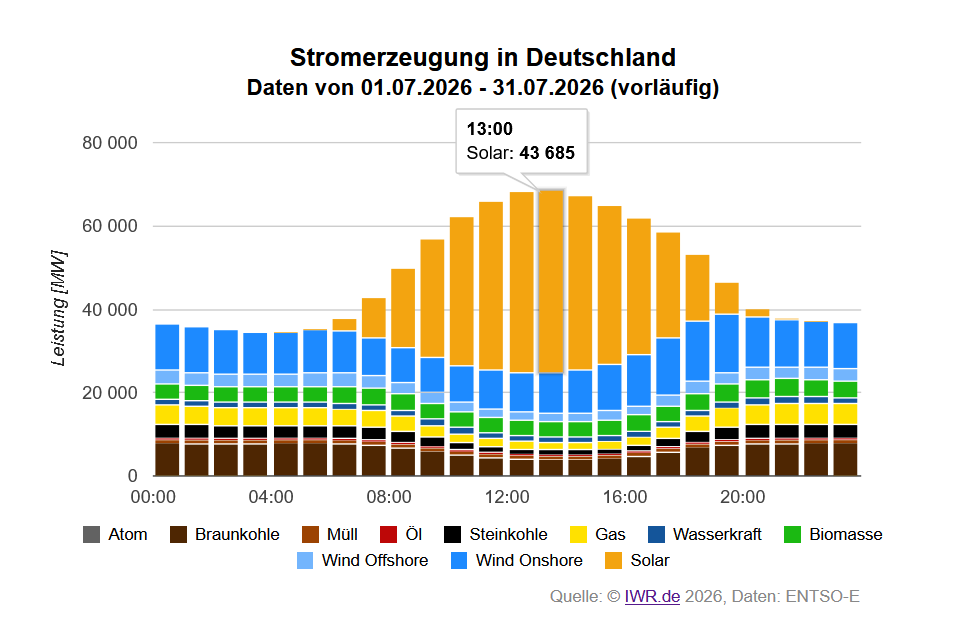
© CR / Adobe StockMünster (renewablepress) - Germany's photovoltaic sector reached a historic milestone in July 2026. For the first time, 12 billion kilowatt-hours (kWh) of solar power were fed into the public electricity grid in a single month. This is the result of an analysis of quarter-hourly feed-in data from the European grid operator platform ENTSO-E, conducted by the Internationales Wirtschaftsforum Regenerative Energien (IWR) in Münster. In fact, total solar power generation is even significantly higher, since solar power consumed directly on-site is not captured in feed-in statistics.
The analysis also highlights the sharply increased importance of photovoltaics for Germany's electricity supply. At midday, solar power output averaged more than 40,000 MW during July. This corresponds to the electrical capacity of more than 40 nuclear power plants at 1,000 MW each. Over the course of the day as a whole, photovoltaics thus displaced a significant share of electricity generation from coal- and gas-fired power plants.
Photovoltaics Becomes a Key Pillar of Power Supply
The July data mark a structural shift in the German power system. Photovoltaics is no longer merely a supplementary technology but has become one of the central pillars of power supply. This development was made possible over the past two decades by millions of private homeowners, farmers, commercial businesses, and small and medium-sized enterprises that invested in solar installations.
Against this backdrop, the currently planned legal framework – particularly for smaller photovoltaic systems – is changing the economic conditions for precisely the group of operators that has driven this expansion.
"Photovoltaics is now a key pillar of Germany's power supply. This makes an objective discussion of the actual EEG differential costs all the more important. The commonly used term 'solar subsidy,' however, is misleading. It creates the impression that every kilowatt-hour fed into the grid is fully paid for from public funds. In reality, under the EEG, new photovoltaic systems only receive compensation for the difference between the exchange price and the statutory feed-in tariff. This misunderstanding continues to shape the public debate to this day," said Dr. Norbert Allnoch, CEO of the Internationales Wirtschaftsforum Regenerative Energien (IWR).
IWR on EEG Solar Support: Differential Costs Are What Matter
New photovoltaic systems on residential buildings currently receive a statutory feed-in tariff of around 7 cents per kilowatt-hour fed into the grid. This often creates the impression that these 7 cents represent the state solar subsidy. That is incorrect.
In fact, the EEG for new photovoltaic systems is based on a differential cost model. The solar power generated is first sold on the electricity exchange. The entire marketing revenue flows into the EEG account. Only the difference between the exchange price and the statutory feed-in tariff is then compensated from the EEG account. Only this difference generates EEG differential costs at all.
An example illustrates the mechanism: If solar power sold on the electricity exchange achieves a price of 5 cents per kilowatt-hour and the statutory feed-in tariff is 7 cents, only 2 cents per kilowatt-hour is compensated from the EEG account. If the exchange price rises to 8 cents per kilowatt-hour, however, the full 8 cents initially flows into the EEG account. The system operator receives their statutory feed-in tariff of 7 cents, while 1 cent remains in the EEG account.
The statutory feed-in tariff for new photovoltaic systems of around 7 cents per kilowatt-hour is now in a similar range to exchange electricity prices. As a result, the actual EEG differential costs for new systems are often significantly lower than the statutory feed-in tariff — or, at sufficiently high market revenues, disappear entirely.
It is therefore not the statutory feed-in tariff that determines EEG differential costs, but exclusively the difference between the exchange price and the statutory feed-in tariff.
Legacy Costs: Historical Compensation Contracts Still Determine EEG Differential Costs Today
Against this backdrop, the public debate over the costs of photovoltaics often falls short. Today's EEG differential costs are predominantly driven by older PV systems, not by newly installed photovoltaic systems with feed-in tariffs of around 7 cents per kilowatt-hour. The regulatory changes currently planned do not affect the compensation rules for older systems, which were installed in particular between 2010 and 2013. Due to the significantly higher investment costs at the time, these systems are still entitled to statutory feed-in tariffs of frequently 30 to over 40 cents per kilowatt-hour.
These compensation entitlements each run for 20 years and will expire gradually between 2030 and 2033. Only once these legacy contracts expire will the historical EEG differential costs decline significantly, independent of the compensation paid for new photovoltaic systems.
Download press images:
https://www.renewablepress.com/press-images/iwr/2d641_Ausbau-Solar-2-AS_414986171.jpg
Caption: New Solar All-Time High in Germany: 12 Billion kWh of Solar Power Fed into the Grid in a Single Month for the First Time
© CR / Adobe Stock
 https://www.renewablepress.com/press-images/iwr/48ce4_IWR_Deutschland-Solarrekord-Juli-26-030826.png
Caption: Average Feed-in Output by Energy Source in Germany in July 2026
© IWR
Münster, 03 August 2026
Publication and Reprint free of charge; please send a voucher copy to Internationales Wirtschaftsforum Regenerative Energien (IWR).
Attention editorial offices - For further questions please contact:
Media contact:
Internationales Wirtschaftsforum Regenerative Energien (IWR)
Dr. Norbert Allnoch
Phone: +49 (0)251 / 23 946–0
Fax: +49 (0)251 / 23 946-10
E-Mail: info@iwr-institut.de
Internationales Wirtschaftsforum Regenerative Energien (IWR)
Soester Str. 13
48155 Münster
Germany
Internet: https://www.iwr-institute.com
Online press kit - all press releases from Internationales Wirtschaftsforum Regenerative Energien (IWR)
Press photos for editorial use only
Note: For the content of this press release the issuer / publisher of the release is »Internationales Wirtschaftsforum Regenerative Energien (IWR)« responsible.
The press release "New Solar All-Time High in Germany: 12 Billion kWh of Solar Power Fed into the Grid in a Single Month for the First Time – IWR Explains Common Misconceptions about EEG Support" von Internationales Wirtschaftsforum Regenerative Energien (IWR) is also available in the following languages:
-
Neues Solar-Allzeithoch in Deutschland: Erstmals 12 Milliarden kWh Solarstrom in einem Monat – IWR erklärt Missverständnisse bei der EEG-Förderung

-
Nuevo récord histórico de la energía solar en Alemania: por primera vez 12.000 millones de kWh de electricidad solar en un mes – IWR explica los malentendidos sobre la retribución del EEG

-
Nouveau record historique de l'énergie solaire en Allemagne : pour la première fois, 12 milliards de kWh d'électricité photovoltaïque en un mois – l'IWR explique les malentendus concernant le mécanisme de soutien EEG

More press releases from Internationales Wirtschaftsforum Regenerative Energien (IWR)
- Oil and Gas Prices: Renewables and Storage Offer the Best Protection Against Price Shocks and Inflation
- Energy Policy: Reiche's Approach Will Lead to Higher Electricity Prices for Industry and Consumers
- Global Nuclear Power Plant Market Stagnates in 2025 and Remains in a Trough
- Green Stocks on the Rise: RENIXX Gains 10.7% in the First Quarter Against Market Trend
- Wind Power in Germany Rises by 27 Percent in Q1 2026 - Electricity Prices Drop
- Germany Surpasses the 10,000 MW Offshore Wind Capacity Mark
- IWR: Number of Battery Storage Systems Exceeds 2 Million – Strong Market Growth in Germany Expected
- Nuclear Power Plants: 37 Nuclear Reactors Permanently Shut Down in Europe Since Fukushima
- Global market for nuclear power plants still at rock bottom in 2024 - Nuclear power too expensive for AI applications
- Wholesale electricity prices fall for the second year in a row in 2024 - electricity prices lower than in 2021
About Internationales Wirtschaftsforum Regenerative Energien (IWR)
In 1996, the International Economic Platform for Renewable Energies (IWR) was established as an independent and private service institution of the renewable energy industry. The IWR focuses on the fields of research, economic and policy consultation as well as media and international networks in the renewable or regenerative energies sector. One main objective of the IWR is to play an instrumental role in introducing and spreading awareness for an industrial, international business profile of the renewable energy industry.
Dr. Norbert Allnoch, Director of the International Economic Platform of Renewable Energies (IWR), 1995, on the definition: "According to our definition, the Renewable Energy Industry is one which takes an interdisciplinary approach to the issue of renewable energy supply (protecting both the climate and resources) and the construction of renewable plants and systems (industry policy for the three areas electricity, heat and fuel."Chronology of the Renewable Energy Industry - Important IWR contributions, including prizes and awards - 2007 Publication of the first structural analysis for a federal state according to the IWR-analysis method for renewable systems engineering and services�(study "Zur Lage der regenerativen Energiewirtschaft in NRW" )2007 International network-contacts:IWR-director Dr. Allnoch speaks with King Harald V. of Norway and �slaug Haga, norwegian minister of energy Presentation of the network / RENIXX in the USA, dialogue with McGinty, environment minister of Pennsylvania2006 IWR starts renewable stock index RENIXX� (